
A Hybrid Grid Tie Inverter connects solar panels, batteries, household loads, and the utility grid in one coordinated system. It converts the panels’ direct current into usable alternating current for home appliances. When solar production exceeds demand, the system can charge a battery or export surplus electricity. When clouds reduce output, stored energy can support selected loads.
That balance matters.
Unlike a standard grid-tie inverter, a hybrid model can manage energy storage and backup operation. However, backup capability is not automatic. The inverter may require a separate battery, protected load panel, and approved transfer equipment. During a grid outage, certified systems isolate the home from utility lines. This prevents dangerous backfeeding and supports safe maintenance.
Real-world performance depends on battery chemistry, inverter capacity, wiring, software settings, and local sunlight. A system that looks powerful on paper may still struggle with pumps, compressors, or electric heating. Load measurements should guide the design. So should realistic nighttime usage.
It is not magic.
This guide explains how a Hybrid Grid Tie Inverter works, where it fits, and what its limitations mean. It also considers efficiency, monitoring, battery safety, installation quality, and long-term maintenance. Manufacturer documentation and qualified electrical professionals remain essential references. Some systems perform differently than expected, especially when settings are poorly matched. That uncertainty deserves attention, not marketing language.
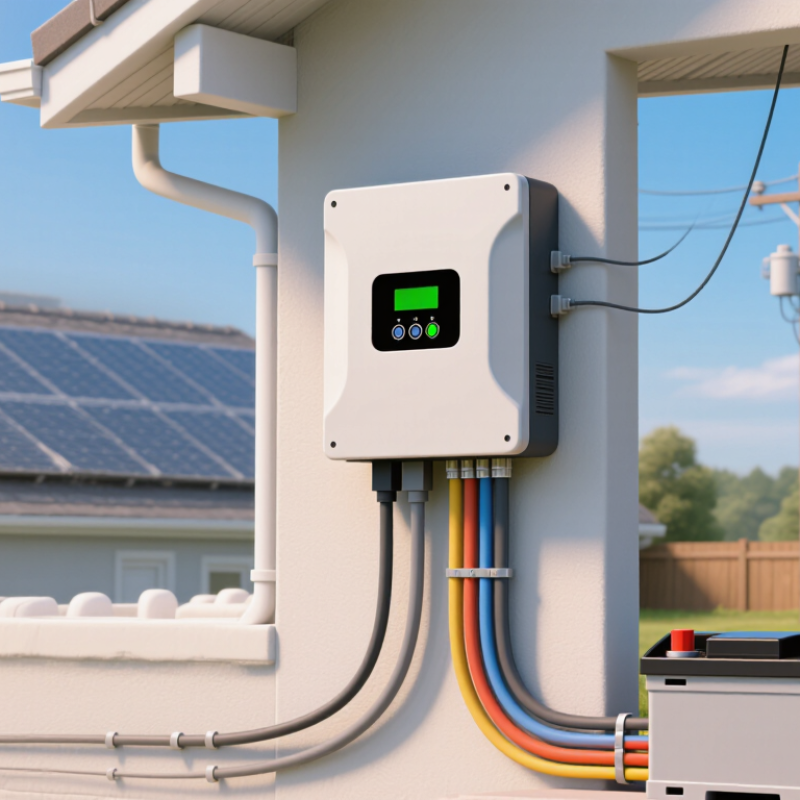
What Is a Hybrid Grid-Tie Inverter?
A hybrid grid-tie inverter connects solar panels, batteries, household loads, and the utility grid. Unlike a standard grid-tie inverter, it can manage stored energy as well. During sunny hours, solar power may run appliances and charge the battery. Excess electricity can flow to the grid, depending on local rules and system settings. At night, the battery can supply selected loads, reducing grid consumption.
The inverter constantly balances power flow. It changes direct current from panels or batteries into usable alternating current for household circuits. During a grid outage, a properly configured system can isolate backup circuits from the utility network. This safety function is essential. Without it, exported electricity could endanger repair workers. A qualified installer should verify wiring, protection devices, battery limits, and local interconnection requirements. From practical system planning, the hardest part is often choosing which loads deserve backup. A refrigerator and internet router may be more useful than an electric heater. The answer is not always obvious.
Tips: Check the inverter’s battery compatibility, backup capacity, and transfer time. Ask whether it supports automatic load management. Keep batteries in a dry, ventilated location. Review performance data after installation, because real household demand may differ from estimates. I once assumed a larger battery solved every problem. It did not. Poor load scheduling can still waste energy, even with advanced equipment.

What Is a Hybrid Grid Tie Inverter?
How a Hybrid Grid-Tie Inverter Works
A hybrid grid-tie inverter connects solar panels, batteries, household loads, and the utility grid. It does more than convert direct current into usable alternating current. Its energy-management system decides where electricity should flow at each moment. The solar array supplies active loads first. Extra power charges the battery or moves to the grid, depending on settings and local rules. The IEA Renewables 2024 report recorded nearly 510 gigawatts of new renewable capacity in 2023. Solar represented about three-quarters of that growth. This expansion makes flexible power control increasingly practical.
During a sunny afternoon, the inverter may send 3 kilowatts to appliances, store 2 kilowatts, and export the remainder. After sunset, it reverses the battery current and supports the home. During a grid failure, certified isolation equipment disconnects the property from utility lines. The inverter can then energize selected backup circuits, such as refrigeration, lighting, and networking equipment. It must not energize the public grid. Anti-islanding protection is essential.
The system is not flawless. Battery losses reduce usable energy, and poor settings can cause unnecessary cycling. A 2024 IEA PVPS Trends report shows how rapidly photovoltaic deployment is scaling worldwide, but generation remains weather-dependent. Professional commissioning should check voltage limits, battery temperature, protection settings, and load priorities. A small wiring mistake can interrupt backup power. Real-world performance depends on installation quality, not only inverter specifications.
| Data Dimension | Hybrid Grid-Tie Inverter | How It Works in Practice |
|---|---|---|
| Basic Definition | A power-conversion device that combines solar PV conversion, battery charging and discharging, grid interaction, and load management. | It can coordinate electricity from solar panels, batteries, the utility grid, and connected loads through one control system. |
| Main Energy Inputs | Solar PV array, battery storage system, and utility grid. | The inverter selects or combines available sources according to solar production, battery state of charge, electricity demand, and programmed priorities. |
| Energy Conversion | Converts the DC electricity from PV modules and batteries into grid-compatible AC electricity; it can also convert AC electricity into DC electricity for battery charging. | Power electronics regulate voltage, frequency, current, and power flow between the DC and AC sides. |
| Normal Daytime Operation | Solar power is normally used to supply local loads first, charge the battery, and export surplus electricity when permitted. | The exact priority is configurable and may depend on self-consumption, backup reserve, time-of-use tariffs, and local regulations. |
| Battery Charging | Can charge the battery from solar energy and, on supported systems, from the utility grid. | Charging limits are controlled by battery voltage, current, temperature, state of charge, and battery-management-system signals. |
| Battery Discharging | Supplies stored electricity to selected loads or the whole backed-up load panel, depending on system design. | Discharge can be scheduled for nighttime use, peak-price periods, or backup operation. |
| Grid-Tied Operation | Synchronizes with the utility grid and can import or export AC power within approved operating limits. | Grid voltage, frequency, anti-islanding protection, and interconnection requirements must be satisfied before export is allowed. |
| Blackout Response | Can isolate designated backup loads from the utility grid and create a local AC supply using solar and battery power. | A transfer device or backup gateway is commonly required to prevent unsafe power feeding into a de-energized utility line. |
| Backup Limitation | Backup availability depends on battery capacity, inverter output rating, solar conditions, and which circuits are connected to the backup output. | Large heating, cooling, pumping, or motor loads may require load management or a higher-rated system. |
| Efficiency Consideration | Energy efficiency varies by operating mode and may be lower when electricity passes through multiple conversion stages. | PV-to-load operation usually avoids unnecessary battery cycling, while charging and later discharging the battery introduces additional conversion losses. |
| Common Control Modes | Self-consumption, backup reserve, time-of-use scheduling, peak shaving, zero export, and grid charging where permitted. | Operating modes are selected through commissioning settings, an energy-management system, or a compatible monitoring interface. |
| Typical Battery Chemistry | Lithium-ion batteries are widely used; other chemistries may be supported depending on inverter compatibility and battery-management requirements. | The inverter and battery must be electrically compatible and, when required, able to communicate through an approved battery-management interface. |
| Safety Functions | Includes anti-islanding protection, overvoltage and overcurrent protection, thermal protection, ground-fault monitoring, and battery protection features. | Protection functions help disconnect or reduce power when abnormal grid, temperature, voltage, current, or insulation conditions are detected. |
| Export Control | May support unrestricted export, limited export, or zero-export operation, subject to system configuration and local approval. | A smart meter or current transformer is commonly used to measure grid import and export at the point of connection. |
| Key Sizing Factors | PV array power, continuous and surge output, battery voltage and capacity, backup-load demand, expected autonomy, and local grid requirements. | Correct sizing requires evaluating both energy needs measured in kilowatt-hours and power demand measured in kilowatts. |
| Primary Benefit | Improves solar self-consumption while adding energy storage, flexible energy management, and backup capability in one integrated architecture. | It can reduce grid purchases and provide resilience, but installation, battery compatibility, protection equipment, and utility approval must be properly addressed. |
Note: Actual functions, ratings, efficiency, backup behavior, and export permissions vary by system design, battery compatibility, installation conditions, and local electrical regulations.
A hybrid grid-tie inverter connects solar panels, batteries, household loads, and the utility grid. Its key components include an MPPT controller, bidirectional battery charger, inverter bridge, transfer switch, monitoring controller, and protection circuits. The MPPT controller extracts usable power as sunlight changes. The battery charger manages charging and discharging limits. The transfer switch isolates selected loads during an outage. That distinction matters.
IEA Renewables 2024 reports nearly 420 GW of solar capacity was added globally in 2023. IRENA’s Renewable Capacity Statistics 2024 records about 1,419 GW of global solar capacity at year-end 2023. More installations make control quality increasingly important.
Operating modes determine how energy moves. In grid-connected mode, solar power serves local loads first, while excess electricity flows to the grid or battery. In self-consumption mode, the inverter prioritizes stored energy after sunset. Backup mode keeps critical circuits powered when grid voltage disappears. Zero-export mode limits output using a meter and control loop. Some systems also support peak-shaving, charging batteries during cheaper tariff periods. Performance can suffer when sensors are poorly placed or battery settings are too aggressive. That is an easy detail to underestimate.
Tips: Check continuous backup power, surge capacity, battery voltage range, and transfer time before installation. Confirm local interconnection rules and electrical protection requirements. Test an outage simulation with real loads, not just a phone application. The “smart” setting is not always the best setting. Record seasonal production and battery losses, then adjust cautiously.
A hybrid grid-tie inverter connects solar panels, batteries, household loads, and the utility grid. Unlike a standard grid-tie unit, it can manage stored energy during outages. It may also charge batteries when electricity prices are lower. This flexibility matters as solar deployment accelerates. The International Energy Agency reported nearly 510 GW of renewable capacity additions in 2023, with solar providing most of the growth. More solar also creates greater demand for controlled energy storage.
The benefits are practical. A hybrid inverter can reduce evening grid purchases, provide limited backup power, and improve self-consumption. Some systems can prioritize essential circuits, such as refrigerators, pumps, and communication equipment. However, backup performance depends on battery capacity, inverter output, and electrical design. Not every model can operate without the grid. Extra equipment also increases installation cost, maintenance needs, and conversion losses. The U.S. Department of Energy notes that battery storage can support resilience and grid services, but performance varies by system configuration and operating conditions.
Oversizing the battery may leave capacity unused for much of the year. Undersizing it can disappoint users during long outages. NREL’s Annual Technology Baseline continues to show that storage costs depend strongly on duration and project scale. Real-world design therefore needs local tariffs, weather data, load measurements, and outage expectations. Manufacturer ratings are useful, but they are not the whole story. A carefully tested system is safer than a powerful system chosen from a brochure.
What Is a Hybrid Grid-Tie Inverter?
A hybrid grid-tie inverter connects solar panels, batteries, household loads, and the utility grid. It converts direct current into usable alternating current. It can also charge batteries and supply stored energy during outages, where local regulations allow backup operation. This flexibility matters as solar deployment accelerates. The IEA’s Renewables 2024 report recorded nearly 420 GW of new solar capacity worldwide in 2023.
How to Choose the Right Hybrid Grid-Tie Inverter
Start with the load profile, not the inverter’s headline power. Check continuous output, short-term surge capacity, and the battery’s usable voltage range. A refrigerator may need several times its running power during startup. Small details become expensive problems.
Review the inverter’s maximum photovoltaic input, MPPT voltage window, and number of independent trackers. Different roof orientations may require separate MPPT channels. Confirm the system’s backup transfer time and whether critical circuits need a dedicated load panel. The IEA’s Batteries and Secure Energy Transitions report estimates that global battery storage must expand to about 1,200 GW by 2030, showing why battery compatibility deserves careful attention.
Efficiency ratings are useful, but they do not describe every operating condition. Ask for weighted efficiency, standby consumption, temperature limits, and documented grid-code compliance. Installation experience also matters; poor cable sizing can undermine good equipment. A perfect choice is unlikely. Recheck assumptions against winter production, future battery additions, and local inspection requirements before purchasing.
Precision Cable Assemblies
16830 Pheasant Drive
Brookfield, WI 53005
Phone: 262-784-7887
Fax: 262-784-0681