
Selecting a Grp Storage Tank is not just a matter of comparing prices. Buyers must consider stored water quality, site conditions, capacity, access for inspection, and the supplier’s technical support. A tank beside a coastal factory may face different exposure and maintenance needs than one installed at a remote farm. Details matter.
The need for dependable storage is clear. The WHO/UNICEF Joint Monitoring Programme’s 2023 report, Progress on Household Drinking Water, Sanitation and Hygiene 2000–2022, estimated that 2.2 billion people lacked safely managed drinking water services in 2022. That figure does not measure GRP tank demand directly, but it highlights the wider need for resilient water infrastructure. For product evaluation, buyers can also consult AWWA D120, a recognized standard covering thermosetting fiberglass-reinforced plastic tanks.
Manufacturer claims still need careful review. Ask for documented design criteria, material specifications, quality-control records, warranty terms, and references for comparable installations. Check how the proposed tank handles local temperature, wind, foundation, and chemical conditions. A polished brochure cannot answer every site question. Even experienced buyers may overlook access for cleaning or future repairs. That is a practical weakness worth admitting.
This guide compares leading manufacturers for global buyers, focusing on technical capability, customization, service, and evidence behind product claims. Its aim is not to declare one universal winner. It is to help purchasers ask sharper questions before committing to a tank that may serve a site for years.
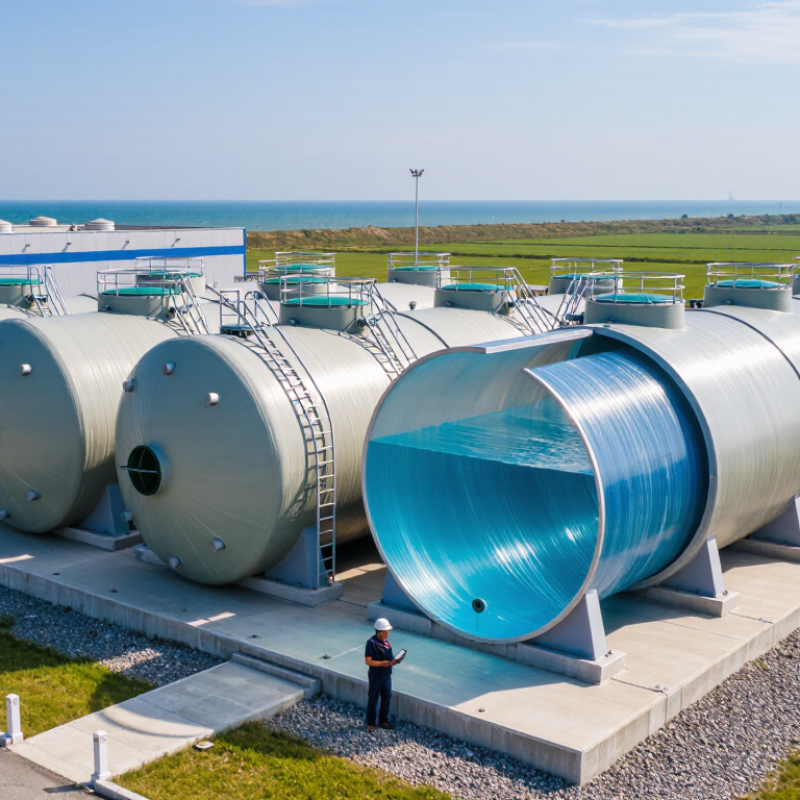
GRP (glass-reinforced plastic) storage tanks are made from resin reinforced with glass fibres. This composite construction provides strength without the weight of many conventional metal tanks. It can also resist corrosion in suitable operating conditions. That does not make every tank suitable for every liquid.
Global applications vary with local climate, infrastructure, and storage needs. Municipal facilities may use GRP tanks for treated water, while factories can store selected process liquids when materials are compatible. Farms and remote sites may value easier transport and installation. Still, temperature, chemical concentration, and cleaning methods can affect tank performance. Check the manufacturer’s technical data against the actual contents, not just a general product description.
Practical details matter. A tank installed outdoors may need protection from prolonged sunlight, and its base must support the filled weight evenly. Access openings, inlet position, and overflow routing should fit the site layout. Small oversights become expensive. Inspection should include joints, supports, fittings, and visible surface changes; a quick look alone may miss developing problems. GRP tanks can serve reliably for years, but service life depends on design, installation, and routine care. A mismatch between tank material and stored contents is easy to overlook, and difficult to correct later.
| Tank Type or Capability | Typical Construction | Common Applications | Key Buyer Considerations | Relevant Standards or Guidance |
|---|---|---|---|---|
| Sectional panel tank | Factory-made glass-reinforced plastic panels assembled on site with bolted connections and sealed joints; internal supports and external framing depend on the design. | Potable-water storage for buildings, hospitals, hotels, industrial facilities, and municipal systems. | Check panel and joint design, access for cleaning, support requirements, potable-water suitability, and whether the site can accommodate assembly and maintenance. | BS EN 13280 covers glass-reinforced plastics tanks for the storage of cold water. |
| Filament-wound tank | Continuous glass-fibre reinforcement wound around a mandrel and combined with a resin system; may be supplied as a vertical or horizontal vessel. | Industrial water, wastewater, chemical storage, and process-liquid service when the selected resin and tank design are suitable. | Confirm liquid composition, concentration, temperature, design pressure or vacuum, resin compatibility, and inspection requirements. | ASTM D3299 addresses filament-wound fiberglass-reinforced thermosetting-resin chemical-resistant tanks. |
| Contact-moulded tank | Layers of glass reinforcement and resin are applied in a mould; construction details and laminate thickness are specified for the service conditions. | Water and chemical storage, including installations where custom dimensions or fittings are required. | Review laminate schedule, quality-control documentation, fitting reinforcement, corrosion barrier, and the design basis for the stored medium. | ASTM D4097 covers contact-moulded fiberglass-reinforced thermosetting-resin chemical-resistant tanks. |
| Potable-water storage configuration | GRP tank materials and internal surfaces are selected for drinking-water contact; configuration may be sectional or one-piece. | Building water systems, remote communities, utilities, and emergency or reserve water storage. | Verify applicable local approvals for materials in contact with drinking water, hygienic access, cleaning provisions, and protection against contamination. | Applicable approvals vary by destination market; confirm local drinking-water regulations and project specifications. |
| Wastewater and drainage storage | GRP construction designed for the stored liquid and site conditions; tanks may include access openings, nozzles, and internal features. | Wastewater treatment, sewage and effluent collection, and industrial drainage systems. | Assess chemical exposure, solids and sediment, ventilation, odour control, anchorage, groundwater conditions, and access for inspection. | Use the relevant project and local codes for structural design, installation, and wastewater service. |
| Chemical storage configuration | Resin system, corrosion barrier, reinforcement, and fittings are selected according to the specific chemical and operating conditions. | Industrial process plants, water treatment, agriculture, and chemical handling facilities. | Provide the manufacturer with the chemical name, concentration, temperature, operating cycle, and any cleaning agents; do not assume universal chemical resistance. | ASTM D3299 and ASTM D4097 address defined GRP tank construction methods; confirm the applicable design and service requirements. |
| Global sourcing and manufacturing capability | Capabilities can include engineering, moulding or winding, panel production, factory inspection, documentation, and on-site assembly support. | Projects across municipal, commercial, industrial, agricultural, and infrastructure sectors. | Compare documented design capacity, quality procedures, traceability, export packaging, delivery schedule, installation support, and local service availability. | Specify the governing standard, design life, load cases, inspection scope, and required certificates in the purchase documents. |