Choosing a reliable Corrugated Steel Pipe supplier requires more than comparing catalog prices. Global buyers must examine steel quality, coating systems, production capacity, testing records, and export experience. A pipe that looks suitable on a screen may fail when exposed to abrasive soil, standing water, heavy traffic, or repeated freeze-thaw cycles.
The World Steel Association reported approximately 1.89 billion tonnes of crude steel production in 2023. This scale shows the strength of the supply base, but it does not guarantee consistent pipe quality. ASTM A760/A760M provides important requirements for corrugated steel pipe, while transportation agencies such as the U.S. Federal Highway Administration emphasize hydraulic design, structural loading, installation, and corrosion assessment. These references help buyers ask better questions. Does the supplier provide mill certificates? Are galvanized coatings tested? Can it maintain dimensional accuracy across large production runs?
Small details matter.
This guide reviews five leading Corrugated Steel Pipe suppliers for international buyers. The comparison considers manufacturing capability, product range, quality documentation, customization, delivery support, and experience with infrastructure projects. It also recognizes an uncomfortable limitation: no supplier is best for every application. A coastal drainage project may need different protection from a rural culvert beneath a gravel road. Freight distance, port access, local standards, and after-sales communication can change the final decision. Buyers should verify current certifications, project references, lead times, and landed costs before signing a purchase agreement. Industry reports provide useful direction, but site conditions still decide performance.
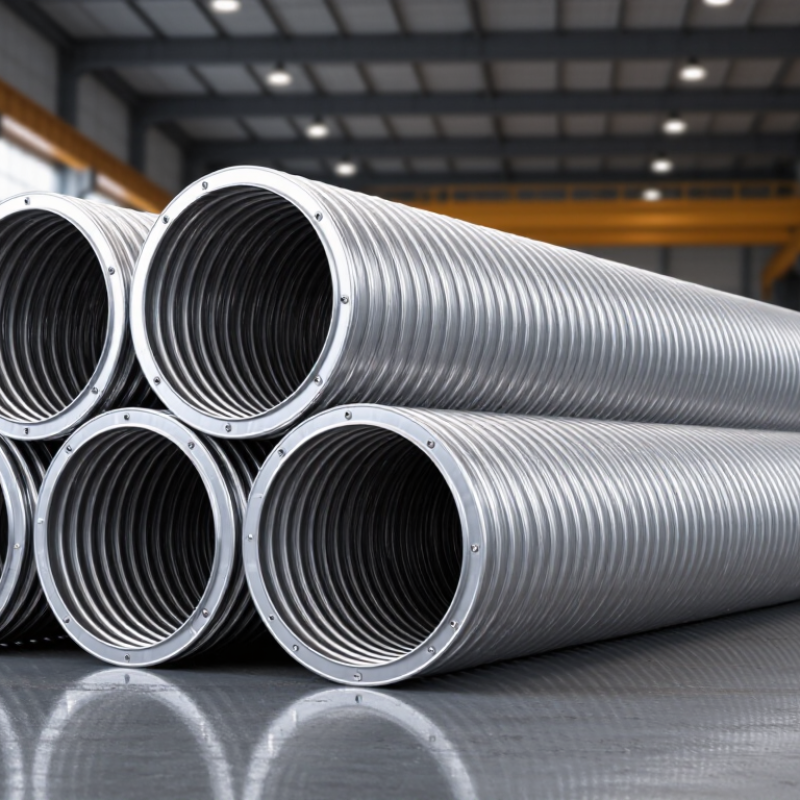
Corrugated steel pipes are round or arched conduits formed with repeated ribs. These corrugations increase stiffness without requiring excessive wall thickness. In practical terms, a pipe can cross beneath a highway while carrying stormwater, sediment, and seasonal runoff. Galvanized or polymer-coated surfaces help resist corrosion, but site chemistry still matters.
Their main global applications include road culverts, railway drainage, agricultural channels, mine-site water control, and stormwater outlets. The Federal Highway Administration’s Hydraulic Design Series No. 5 identifies corrugated metal pipes as established culvert options for highway drainage design. Engineers normally check rainfall intensity, hydraulic capacity, soil loading, cover depth, and outlet erosion. A 1.2-meter pipe under a rural road may need a different coating and thickness from a similar pipe beneath an industrial yard.
Material availability also supports international sourcing. The World Steel Association reported about 1.89 billion tonnes of crude steel production in 2023, showing the scale of the global steel supply base. However, steel volume alone does not guarantee a suitable pipe. Regional standards, groundwater acidity, installation quality, and maintenance access can change service life significantly.
Some projects still underestimate bedding requirements. That mistake can cause deformation, even when the pipe specification looks correct. Suppliers should provide test data, coating details, load calculations, and installation guidance rather than relying on catalog dimensions alone.

A reliable supplier should prove manufacturing control, not just offer a low price. The World Steel Association reported 1,888.2 million tonnes of crude steel production in 2023. This scale does not guarantee consistent pipe quality. Ask for heat numbers, mill certificates, dimensional records, and coating test results. Confirm whether production is direct or outsourced. That distinction affects traceability.
Tips: Request samples before signing a large contract. Compare wall thickness, corrugation depth, seam quality, and zinc coating mass. Use independent inspection for the first shipment. A supplier should understand ASTM, AASHTO, or equivalent project specifications. Certificates without batch references are weak evidence. I have found that polished documents can still hide poor communication.
Logistics deserves equal attention. UNCTAD’s Review of Maritime Transport states that shipping carries over 80% of global merchandise trade by volume. Therefore, assess export packing, port access, container loading, and damage procedures. Request a realistic production schedule, not a perfect promise. Check how quickly the supplier answers technical questions. Slow replies often become costly during customs clearance or installation. Price comparisons can mislead. Freight, duties, testing, and replacement costs may change the final figure. My own assessment would remain incomplete without checking references from projects using similar soil, rainfall, and traffic conditions.
5 Best Corrugated Steel Pipe Suppliers for Global Buyers
Supplier Profile One: Product Range, Standards, and Export Capabilities
A dependable corrugated steel pipe supplier should offer more than a wide catalogue. Its range may include galvanized pipes, polymer-coated pipes, aluminized steel pipes, and structural plate systems. Diameters often span from small drainage sizes to large stormwater conduits. Some projects also require flared ends, coupling bands, or custom fittings. These details affect installation speed and long-term performance.
Standards matter at the job site. Experienced suppliers should identify applicable requirements, such as AASHTO M36, ASTM A929, or relevant EN specifications. They should provide coating thickness records, steel grade information, dimensional reports, and mill certificates. Product drawings must match the purchase order. Small errors can create expensive delays. Ask for independent test results when the project involves heavy traffic loads or aggressive soil.
Export capability is equally practical. A capable supplier can prepare seaworthy bundles, moisture-resistant packaging, loading photographs, and complete commercial documents. They should understand container limits, port schedules, and destination inspection procedures. Communication matters too. One clear contact reduces confusion across time zones. Still, no profile is perfect. A supplier may have strong manufacturing control but limited experience with remote installation support. That gap deserves direct questions before payment. Request recent project references, sample documents, and a realistic production timeline. Not promises. Evidence.
Supplier Two focuses on high-volume corrugated steel pipe production for drainage and culvert projects. Its factory uses automated forming lines, robotic welding, and galvanized steel coils with documented thickness controls. This setup supports consistent diameters and faster production for infrastructure contractors. Its market coverage includes Southeast Asia, the Middle East, Africa, and selected European regions. Export experience matters here. Packaging must protect pipe edges during long sea journeys.
Supplier Three serves buyers needing custom shapes, coatings, and connection systems. Its engineers review soil conditions, load requirements, and installation methods before confirming specifications. That practical process reduces costly changes after delivery. Supplier Four has stronger regional coverage, with warehouses and technical teams near major construction markets. Shorter delivery routes can improve project scheduling. However, its product range may be narrower than expected. Supplier Five offers flexible batch sizes and private technical support for distributors. It reaches North America, Latin America, and several island markets, but smaller orders may carry higher unit costs.
Tips: Request mill certificates, coating-test records, and recent project references. Compare delivered cost, not only factory price. Ask how the supplier handles damaged sections, replacement claims, and dimensional disputes. A factory visit can reveal more than a polished brochure. Still, one visit cannot prove long-term consistency. Check independent inspection options before placing a large order.
Comparative procurement index based on practical buyer criteria: manufacturing capability, product customization, standards readiness, and international market coverage. Scores are indicative and shown without company or brand names.
Higher scores indicate broader production capability, greater customization flexibility, stronger export readiness, and wider geographic coverage.
Comparing Prices, Certifications, Delivery, and After-Sales Support
Choosing among five corrugated steel pipe suppliers requires more than comparing unit prices. In my procurement experience, the cheapest quotation often hides higher freight, coating, or inspection costs. Request a full landed-cost breakdown, including packaging, export documents, inland transport, and destination charges. Small details matter.
Certification should match the project’s location and use. Reliable suppliers can provide ISO 9001 quality records, material certificates, coating specifications, and recent test reports. Ask for traceability from steel coil to finished pipe. Third-party inspection can verify diameter, wall thickness, galvanizing, and joint dimensions before shipment. A certificate alone is not proof of consistent production.
Delivery performance deserves equal attention. Confirm production capacity, realistic lead times, loading photos, and container plans. Pipes should be separated with protective spacers and secured against deformation. Port congestion can change schedules, so written updates are valuable. Fast delivery is helpful, but rushed production may create quality problems.
After-sales support reveals a supplier’s practical reliability. Check whether claims receive a response within one or two business days. Request a clear process for damaged goods, missing components, and installation questions. Spare couplers and replacement parts can prevent costly site delays. I once focused too heavily on price and overlooked communication quality. That decision saved money initially, but created weeks of avoidable coordination work.
Precision Cable Assemblies
16830 Pheasant Drive
Brookfield, WI 53005
Phone: 262-784-7887
Fax: 262-784-0681