China Top 10 Thermal Expansion Vessel Manufacturers?
China’s thermal equipment industry has expanded alongside rising demand for efficient heating, cooling, and hot-water systems. The International Energy Agency’s Energy Efficiency 2023 report states that buildings consume about 30% of global final energy and produce approximately 26% of energy-related emissions. These figures explain why reliable pressure-control components matter.
A Thermal Expansion Vessel protects closed-loop systems from pressure increases caused by water expansion. In practice, a weak diaphragm, incorrect pre-charge, or poor weld can create leaks and repeated safety-valve discharge. The component may look simple. Its performance is not.
This guide examines China’s top 10 Thermal Expansion Vessel manufacturers through practical procurement criteria. These include vessel volume, working pressure, temperature range, diaphragm quality, corrosion protection, factory testing, and certification evidence. EN 13831 and EN 12828 provide useful technical references for sealed heating systems, while ISO 9001 can support quality-management evaluation. However, certification alone does not prove long-term field reliability.
Market research from Grand View Research and related HVAC equipment studies shows continuing growth in heating, ventilation, and hot-water applications. Exact vessel-market figures vary between research firms. That inconsistency deserves caution. Public manufacturer data is also uneven.
The selected companies are assessed using product portfolios, manufacturing capabilities, export experience, technical documentation, and customer-support signals. Factory audits and sample testing remain essential before large orders. A polished website is not enough.
This ranking is not permanent. Supplier performance can change with ownership, materials, production control, or market focus. Buyers should verify current certificates, pressure-test records, and diaphragm specifications directly with each manufacturer. The strongest supplier is not always the largest one. It is the one that consistently matches the vessel to the system.
Thermal Expansion Vessels: Purpose, Structure, and Operating Principles
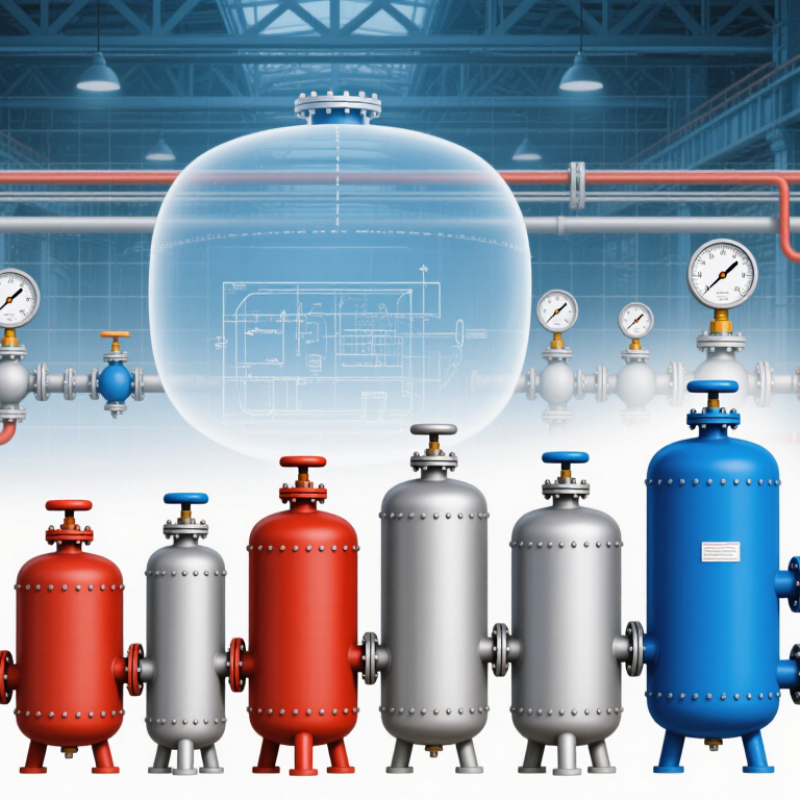
A thermal expansion vessel protects closed-loop heating and water systems from pressure changes. When fluid warms, its volume increases. Without room to expand, pressure can rise sharply and strain pipes, seals, pumps, and safety valves.
The vessel usually contains a steel shell, a flexible diaphragm or bladder, an air valve, and a water connection. The diaphragm separates system fluid from compressed air or nitrogen. During cold filling, the vessel holds its pre-charge pressure. As water heats, it enters the vessel and compresses the gas cushion. When the system cools, the stored fluid returns to the circuit. Simple principle. Careful sizing matters.
Selection depends on system volume, operating temperature, maximum pressure, fluid type, and installation height. A practical inspection should check the pressure gauge, vessel corrosion, connection leaks, and pre-charge condition. The vessel must be isolated and safely depressurized before testing. Do not rely on appearance alone. A vessel may look sound while its bladder has failed. I have also seen incorrect pre-charge settings cause frequent safety-valve discharge. That mistake is easy to miss. Manufacturer data, test records, and competent installation provide stronger evidence than price alone. In China’s manufacturing market, buyers should compare material certificates, pressure-test documentation, weld quality, and after-sales technical support. Selection still requires engineering judgment.
China’s Thermal Expansion Vessel Manufacturing Landscape
China’s thermal expansion vessel manufacturing landscape is broad, practical, and increasingly specialized. Factories range from compact workshops to automated plants serving heating, solar, water, and industrial systems. A typical production line includes steel shell forming, diaphragm fitting, welding, coating, and pressure testing. Details matter. A vessel may look simple, yet membrane compatibility and pre-charge stability affect system life.
Experienced manufacturers usually control key steps through material checks, weld inspection, leak testing, and batch traceability. They also adapt connections, volumes, mounting formats, and valve assemblies for different projects. Export-oriented facilities often review pressure ratings, operating temperatures, fluid types, and market requirements before production. Certification alone is insufficient. Test records should match the actual vessel.
The market still has uneven capability. Some suppliers communicate well but provide limited long-term performance data. Others offer low prices while overlooking installation conditions or incorrect pre-charge settings. Buyer judgment remains important. Request drawings, test procedures, diaphragm materials, and replacement guidance. Ask about failure investigations. A responsible factory should answer clearly, even when the answer reveals a process weakness. Manufacturing quality improves through honesty, not polished claims.
This chart presents representative maximum working-pressure ratings commonly specified for thermal expansion vessels used in China’s heating, solar thermal, potable-water, and chilled-water systems. Actual ratings vary by vessel design, certification, and application requirements; the data does not represent individual manufacturers or brands.
Applications, Certification, and Purchasing Considerations
China Top 10 Thermal Expansion Vessel Manufacturers: Applications, Certification, and Purchasing Considerations
Thermal expansion vessels support closed-loop heating, cooling, solar thermal, and domestic water systems. They absorb pressure changes when water temperature rises.
In a plant room, correct sizing can prevent frequent safety-valve discharge and pump stress. The IEA’s Global Status Report for Buildings and Construction reports that buildings consume about 30% of global final energy. Efficient hydronic controls therefore deserve practical attention.
Certification should match the installation location.
For European projects, check conformity with the Pressure Equipment Directive 2014/68/EU and relevant EN 13831 requirements. ASME Section VIII may be required for certain North American projects.
Potable-water vessels should also have suitable contact-material approvals, such as NSF, WRAS, or equivalent national certification. Ask for certificates, test pressure records, weld inspection details, and traceability documents. A logo alone proves little.
Purchasing teams should compare usable acceptance volume, diaphragm material, temperature range, connection size, and pre-charge stability.
A vessel rated for 10 bar may perform poorly if the system pressure is poorly calculated. Request sizing based on fluid volume, operating temperature, static height, and relief-valve setting.
The IEA notes that heat-pump deployment is expanding as buildings decarbonize, increasing demand for reliable hydronic components.
The ranking is useful, but not enough. Factory audits, sample testing, spare-part access, and after-sales response often reveal more than a polished catalogue. Mistakes remain possible. That is why independent verification is worth the cost.