China Top 10 Copper Busbar Extrusion Machine Manufacturers
China Top 10 Copper Busbar Extrusion Machine Manufacturers introduces the companies shaping modern copper conductor production. These manufacturers serve electrical, renewable-energy, railway, transformer, and industrial applications. Their equipment must produce dense, smooth, and accurately sized busbars.
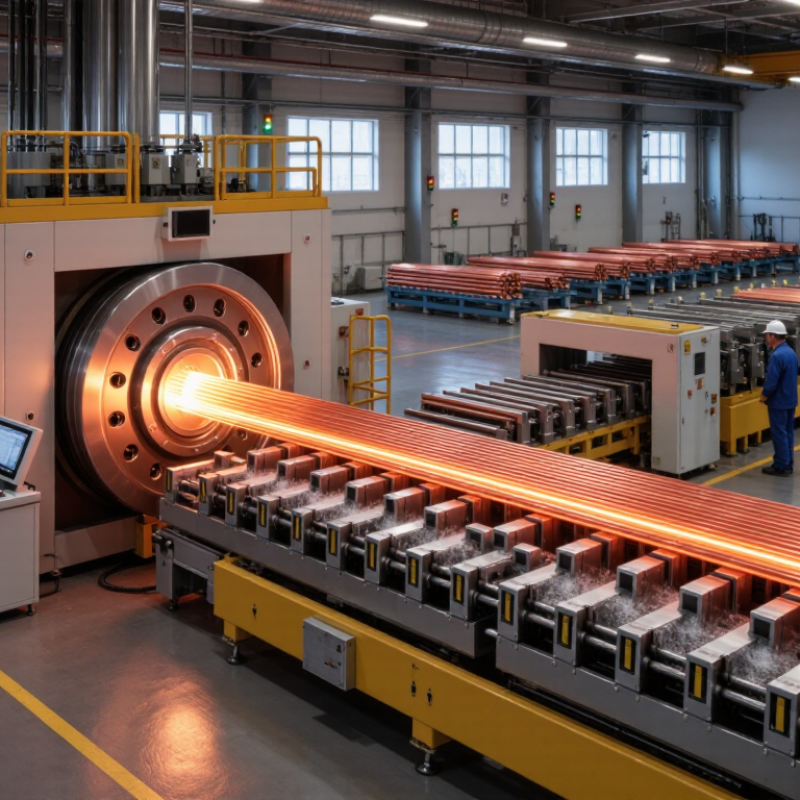
A Copper Busbar Extrusion Machine typically combines a copper billet heater, extrusion wheel, forming die, cooling system, puller, and cutting unit. Each section affects final conductivity and dimensional stability. Small temperature changes can alter surface quality. Poor alignment may create uneven edges or inconsistent thickness. The machine should also support practical maintenance, stable production speed, and traceable quality checks.
Quality expert W. Edwards Deming wrote, “Quality comes not from inspection, but from the improvement of the production process.” This principle remains useful when comparing copper extrusion manufacturers. A reliable supplier should explain its die design, copper grades, output range, energy use, testing methods, and after-sales response. Factory acceptance tests matter. So do customer references.
This ranking is not absolute. Public information varies between manufacturers, and some performance claims require independent verification. That is an important weakness. A machine may look impressive in a brochure yet struggle with long production runs. Buyers should examine sample busbars, conductivity results, surface finish, tolerance records, and spare-parts availability.
The following overview compares China’s leading manufacturers through technical capability, engineering experience, customization, service support, and market credibility. It also considers details often overlooked, including installation training, cooling consistency, control-system usability, and the manufacturer’s willingness to discuss failures honestly. That last point can reveal more than polished marketing.
Copper Busbar Extrusion Machines: Definition, Functions, and Applications
Copper busbar extrusion machines are industrial systems that form copper into precise, continuous profiles. They use controlled pressure to push copper through a shaped die. Depending on the process, the material may be heated or fed at a controlled temperature. The result can be a flat bar, tube, or customized conductive section. These machines manage feeding, extrusion force, cooling, cutting, and length control. Their performance directly affects conductivity, surface quality, dimensional accuracy, and production speed. A stable die temperature matters. Even a small temperature change can create uneven edges or surface marks.
Copper busbars are widely used in switchgear, substations, transformers, railway systems, and charging equipment. They also support solar inverters and industrial power distribution cabinets. In practical production, operators inspect width, thickness, straightness, burrs, and electrical resistance. Some lines include online measuring systems, but manual checks remain valuable. A sensor can miss a defect during vibration or calibration drift. Machine buyers should examine die life, cooling design, control accuracy, maintenance access, and technical documentation. Experience shows that maximum speed is not always the best choice. Excessive speed may increase scrap and reduce profile consistency. A reliable machine should match the copper grade, cross-section, yearly output, and available workshop skills. The selection process is rarely perfect. Real production conditions often reveal limitations that a catalog cannot show.
Key Criteria for Evaluating Chinese Extrusion Machine Manufacturers
Choosing among China’s top copper busbar extrusion machine manufacturers requires more than comparing prices. Review their experience with copper alloys, billet sizes, busbar widths, and required dimensional tolerances. A capable manufacturer should explain extrusion force, puller speed, heating control, cooling design, and expected production output. Ask for test data from a similar line, not only polished catalog figures. Real evidence matters.
Inspect the factory remotely or in person. Check machining quality, electrical cabinet labeling, safety guards, and assembly discipline. Request references from operating plants and ask about downtime, commissioning delays, and spare-part response times. Certification helps, but it does not replace technical proof. Some suppliers provide excellent engineering yet weak documentation. That gap can create costly confusion during installation. No manufacturer is perfect.
Tips: Prepare a technical checklist before contacting suppliers. Include copper grade, billet diameter, busbar dimensions, tolerance limits, production speed, and available workshop space. Ask whether the quoted capacity includes scrap, setup time, and operator adjustments. Confirm software access, training hours, warranty limits, and remote support. A live trial using your material is stronger than a video demonstration. Also, inspect maintenance points closely. Grease ports, heater replacement access, and die-changing procedures affect daily productivity. Small omissions often become large expenses.
China Top 10 Copper Busbar Extrusion Machine Manufacturers
Key Criteria for Evaluating Chinese Extrusion Machine Manufacturers
This evaluation framework assigns a 100-point procurement weighting to the main factors used when comparing copper busbar extrusion machine suppliers. Product quality, dimensional accuracy, production capacity, automation, energy efficiency, compliance, service support, delivery reliability, customization, and total cost are assessed without using individual company or brand data.
Profiles of China’s Top 10 Copper Busbar Extrusion Machine Manufacturers
China’s leading copper busbar extrusion machine manufacturers serve different production needs. Their strengths are rarely identical.
Profile One focuses on compact presses for small electrical workshops.
Profile Two develops high-pressure systems for thick copper sections.
Profile Three emphasizes automatic billet heating and stable temperature control.
Profile Four specializes in multi-opening dies for repeated profiles.
Profile Five supports large conductors used in substations and industrial power cabinets.
Profile Six combines extrusion presses with online straightening equipment.
Profile Seven provides modular lines, which simplify future capacity upgrades.
Profile Eight concentrates on energy-saving hydraulic systems and shorter cycle times.
Profile Nine is known for process monitoring, including pressure, speed, and cooling records.
Profile Ten offers engineering support for die trials, installation, and operator training.
In practical evaluations, buyers should inspect more than catalogue capacity. Ask for sample tolerances, surface-finish results, and actual copper conductivity data. A reliable supplier should explain billet diameter, extrusion ratio, press stroke, and cooling design clearly. Factory visits can reveal maintenance habits, spare-part storage, and testing discipline. Small details matter.
Performance is not always perfect. Some lines need manual adjustment during the first production runs. That is normal, but poor documentation creates avoidable downtime. Experienced manufacturers usually provide trial reports, electrical drawings, lubrication plans, and response procedures. These records help separate impressive claims from dependable engineering.
Comparison of Technologies, Production Capacity, and Quality Standards
China’s top ten copper busbar extrusion machine manufacturers should be compared through measurable performance, not marketing claims. The USGS Mineral Commodity Summaries 2024 reported global mined copper production of about 22 million metric tons in 2023. This pressure makes stable, high-throughput equipment increasingly important.
Technology separates the leading suppliers. Modern lines combine direct extrusion, automatic billet heating, closed-loop pressure control, and inline dimensional inspection. A practical comparison should examine press force, annual output, die-change time, and energy use per tonne. High capacity is not enough. Buyers should request verified production records, because brochure figures can exceed factory performance.
Quality standards also require close review. ISO 9001 supports controlled procedures, while ISO 14001 indicates environmental management. Busbar production should reference relevant ASTM or IEC requirements for conductivity, dimensions, surface condition, and mechanical strength. The International Copper Study Group forecast refined copper usage near 26.5 million tonnes in 2024, showing why consistency matters across large orders. Samples should be tested for conductivity, straightness, tensile behavior, and microscopic defects. Factory audits remain valuable. Even strong suppliers may show uneven documentation, delayed calibration, or unclear warranty terms. That imperfection deserves attention before ranking the top ten.
How to Select the Right Chinese Copper Busbar Extrusion Machine Manufacturer
Choosing among China’s top copper busbar extrusion machine manufacturers requires more than comparing quotations. In production visits, I check whether the supplier understands your copper grade, cross-section range, and monthly output. A machine designed for narrow strips may struggle with thick, wide busbars. Ask for measured samples, not polished photographs. Request billet diameter, extrusion force, line speed, and actual energy consumption. These figures reveal whether the proposal fits your workshop. I once underestimated die-change time. That mistake reduced a planned shift by nearly an hour.
Evaluate engineering depth through a practical trial. Send your drawings and require testing with similar copper material. Inspect surface scratches, dimensional tolerance, corner radius, and straightness after cooling. Ask how the system controls billet temperature, ram pressure, lubrication, and water flow. Stable control matters more than advertised speed. Review the die design process and spare-part lead times. A reliable manufacturer should explain failure modes clearly, including overheating, blockage, and uneven feeding. Honest limitations build more trust than perfect promises.
Factory verification should include assembly quality, wiring, guarding, documentation, and final testing. Check whether electrical components have traceable specifications and whether manuals match the delivered control panel. Request installation support, operator training, and response times in writing. Compare warranty coverage, remote diagnostics, and service arrangements. Price still matters, but low initial cost can hide expensive downtime. My selection criteria changed after a capable machine suffered from weak commissioning support. Leave room for doubt. Record every assumption and test it before signing.
China Top 10 Copper Busbar Extrusion Machine Manufacturers - How to Select the Right Chinese Copper Busbar Extrusion Machine Manufacturer
| Rank | Anonymous Manufacturer Profile | Typical Process | Suitable Copper Grades | Typical Busbar Cross-Section | Typical Output Range | Typical Line Speed | Main Drive Power | Automation Level | Quality-Control Focus | Best-Fit Buyer | Selection Score |
| 1 | Profile A | Continuous copper extrusion | E-Cu, Cu-ETP, Cu-OF | 100–1,200 mm² | 300–1,000 kg/h | 2–8 m/min | 250–500 kW | PLC with HMI and recipe storage | Dimensional stability and surface finish | Large-volume busbar producers | 9.4/10 |
| 2 | Profile B | Conform-type copper extrusion | E-Cu, Cu-ETP | 80–800 mm² | 200–700 kg/h | 1.5–6 m/min | 200–400 kW | Automatic temperature and speed control | Electrical conductivity and straightness | Medium-to-large production plants | 9.1/10 |
| 3 | Profile C | Continuous extrusion with online cooling | E-Cu, Cu-ETP, low-oxygen copper | 60–650 mm² | 180–600 kg/h | 1–5 m/min | 160–315 kW | Semi-automatic with digital monitoring | Cooling uniformity and profile accuracy | Power-distribution component suppliers | 8.8/10 |
| 4 | Profile D | Copper rod-fed extrusion | E-Cu, Cu-ETP | 50–500 mm² | 150–500 kg/h | 1–4 m/min | 132–280 kW | PLC control with manual adjustment options | Material utilization and stable feeding | Custom-profile and batch production | 8.5/10 |
| 5 | Profile E | Integrated extrusion and take-up line | E-Cu, Cu-ETP, Cu-OF | 100–900 mm² | 250–800 kg/h | 2–7 m/min | 220–450 kW | High automation with closed-loop tension control | Length accuracy and coil consistency | Export-oriented manufacturers | 8.4/10 |
| 6 | Profile F | Compact continuous extrusion | E-Cu, Cu-ETP | 30–350 mm² | 100–350 kg/h | 0.8–3.5 m/min | 90–200 kW | Basic PLC and operator panel | Low operating cost and ease of maintenance | Small and medium-sized fabricators | 8.1/10 |
| 7 | Profile G | Extrusion with online straightening | E-Cu, Cu-ETP | 60–600 mm² | 160–550 kg/h | 1–5 m/min | 160–315 kW | PLC with length and alignment sensors | Flatness, edge quality, and alignment | Switchgear and transformer-component suppliers | 7.9/10 |
| 8 | Profile H | Flexible copper extrusion line | E-Cu, Cu-ETP, Cu-OF | 40–450 mm² | 120–450 kg/h | 1–4.5 m/min | 110–250 kW | Semi-automatic with adjustable tooling | Tooling flexibility and changeover time | Multi-product job shops | 7.7/10 |
| 9 | Profile I | Entry-level copper extrusion | E-Cu, Cu-ETP | 25–250 mm² | 80–250 kg/h | 0.5–2.5 m/min | 75–160 kW | Manual setup with basic digital control | Affordable commissioning and simple operation | New entrants and low-volume producers | 7.3/10 |
| 10 | Profile J | Custom-built copper profile extrusion | E-Cu, Cu-ETP, Cu-OF | 50–700 mm² | 130–550 kg/h | 1–5 m/min | 132–315 kW | Customized PLC and data-recording system | Engineering support and special profiles | Customers requiring non-standard dimensions | 7.1/10 |
Selection note: The technical figures shown are representative ranges commonly quoted for Chinese copper busbar extrusion equipment. Actual performance depends on copper grade, billet or rod dimensions, busbar geometry, tooling design, cooling capacity, electrical standards, and production conditions. Before purchasing, request a material trial, dimensional inspection report, electrical-conductivity test, machine layout, spare-parts list, warranty terms, installation scope, and after-sales response commitment.