Choosing 304 Stainless Steel Cups can feel straightforward: the label sounds reassuring, and the polished surface catches the light. Yet grade alone does not tell you how a cup is made, how comfortable its rim feels, or whether its lid fits securely. These details matter when a cup travels in a work bag or sits beside a computer. A useful materials-selection principle from Michael F. Ashby, a leading materials scientist, is to match a material’s properties to the job. That is a paraphrase of his approach, not a direct quotation. For buyers, it means checking construction and intended use, not just the words “304 stainless steel.”
Industry data provides context, but not a shortcut. The International Stainless Steel Forum reported global stainless-steel production of about 58.4 million tonnes in 2023. That figure covers stainless steel broadly; it does not measure cup sales or verify any particular product. ASTM A240/A240M describes requirements for stainless-steel plate, sheet, and strip, including 304 grades, but it is not a consumer cup-quality rating. Look closely at the cup’s specifications, seams, finish, weight, and lid design. Ask whether the seller identifies the material used for both the body and any inner components. Be cautious with claims that lack documentation. Small clues count. A rough rim or a loose-fitting lid can matter more in daily use than a glossy product photo. These ten tips will help you compare 304 Stainless Steel Cups with clearer expectations—and question a few assumptions along the way.
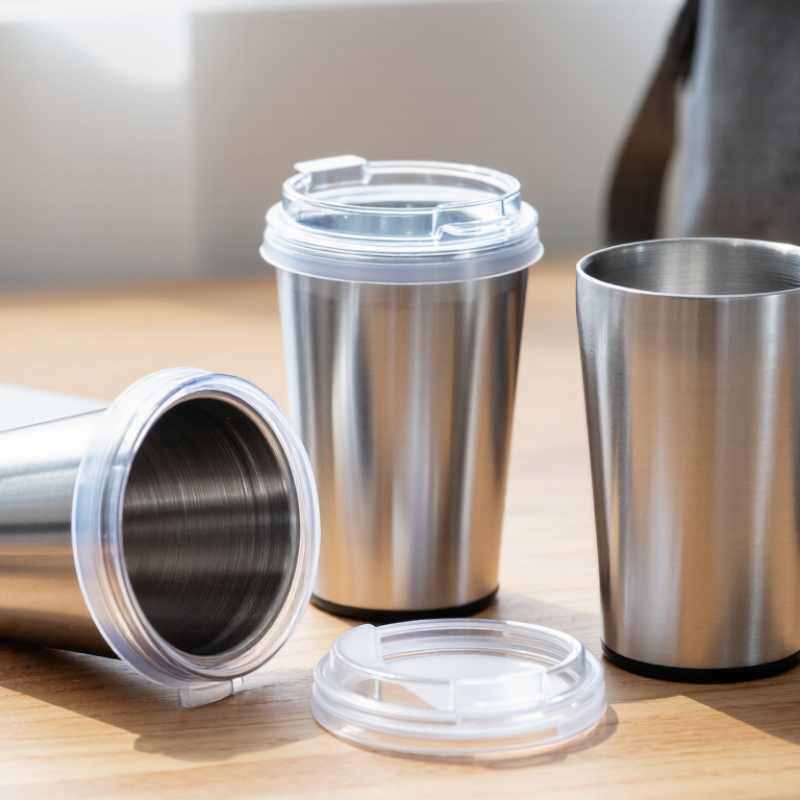
When buying 304 stainless steel cups, check the material documentation, not just the product description. ASTM A240 Type 304 specifies 18–20% chromium and 8–10.5% nickel by weight. Chromium supports corrosion resistance, while nickel helps maintain the steel’s structure and workability. These figures are useful checks, but chemistry alone does not prove that a finished cup is well made.
Tip: Ask for a mill test certificate linked to the sheet or coil used for production. Compare its grade and reported chromium and nickel values with the stated ranges. A handheld XRF test can check these elements, but it does not reliably measure carbon. Keep that limitation in mind.
Look for clear material traceability from the certificate to the cup batch. A magnet is not a dependable grade test; forming can make 304 slightly magnetic. Also inspect the rim, seams, and interior for rough edges, pits, or uneven finishing. Small details matter when a cup is washed every day. If a seller provides only a generic “304” claim, ask what evidence supports it. That may feel fussy, but it is better than guessing from shine alone.
| No. | Buying Tip | What to Check | Practical Acceptance Check |
|---|---|---|---|
| 1 | Verify the material specification | Ask whether the cup’s stainless-steel sheet or strip is specified as ASTM A240/A240M Type 304. ASTM A240/A240M covers stainless-steel plate, sheet, and strip—not every finished-cup performance requirement. | Request documentation that identifies Type 304 and the applicable specification edition. Confirm separately that the finished cup meets your product and food-contact requirements. |
| 2 | Confirm the full Type 304 chemistry | For Type 304 under ASTM A240/A240M, the typical specified limits are chromium 18.0–20.0%, nickel 8.0–10.5%, carbon 0.07% maximum, manganese 2.00% maximum, silicon 0.75% maximum, phosphorus 0.045% maximum, and sulfur 0.030% maximum. | Compare the mill test report’s heat analysis with the applicable standard. Do not rely on a statement that the product is “18/8” alone; it does not document every required element or the tested heat. |
| 3 | Request traceable test documentation | Check that the material test report identifies the grade, heat or lot number, chemical analysis, and relevant mechanical test results. The reported material should be traceable to the production lot. | Match the heat or lot number on the documentation to supplier records and, where available, packaging or production records. Treat an untraceable generic certificate as limited evidence. |
| 4 | Use material identification tests appropriately | Portable X-ray fluorescence (XRF) can help check chromium and nickel, but it does not reliably measure carbon. Surface condition, coatings, geometry, and calibration can affect readings. | Use XRF as a screening check, not as a substitute for a full chemical analysis. If carbon or formal compliance must be verified, use an appropriate laboratory method and a representative sample. |
| 5 | Check every stainless-steel component | A cup may use different materials for its inner wall, outer wall, rim, base, handle, lid, or drinking spout. Confirm which parts are 304 and identify any other metals or polymers. | Obtain a component or bill-of-materials list. Do not assume the entire product is Type 304 because one surface or the product description says “304.” |
| 6 | Specify and measure wall thickness | Wall thickness affects weight, rigidity, and feel. There is no single thickness that is correct for every cup design; formed parts may also vary locally. | Set a nominal thickness and tolerance in the purchase specification, then measure samples at agreed locations with a suitable instrument. Compare results with the agreed drawing or specification. |
| 7 | Inspect seams, welds, and the rim | Look for incomplete joints, cracks, sharp edges, burrs, uneven finishing, and gaps that may trap residue. Weld appearance alone does not establish corrosion resistance or hygiene. | Inspect representative samples visually and by touch; check seams and rim finishing against agreed workmanship criteria. Define any additional weld or leak testing needed for the design. |
| 8 | Check the interior finish and cleanliness | Review the inside surface for pits, scratches, scale, embedded particles, or residue. Surface finish requirements should be specified for the intended use rather than assumed from the grade. | Set a visual cleanliness and finish standard, inspect samples under consistent lighting, and confirm the cleaning process leaves no visible manufacturing residue. |
| 9 | Test the finished cup for its intended use | Material grade alone does not prove that a cup is leakproof, thermally insulating, dishwasher-safe, or suitable for every beverage. These properties depend on construction, seals, coatings, and care instructions. | Agree on product-specific tests, such as leak checks, fit checks, or thermal performance tests, and request results from representative finished units using the defined method. |
| 10 | Define inspection and compliance requirements | Food-contact rules and documentation vary by market and by component. A stainless-steel grade designation by itself does not certify the complete cup for every jurisdiction or use. | Specify the destination market, required declarations or test reports, sampling plan, acceptance criteria, and documentation to be supplied with each production lot. |