What Is the Best Type of Reflow Machine for PCB Assembly?
Choosing the best Reflow Machine for PCB assembly starts with the boards, not the brochure. A compact prototype line has different needs from a factory running panels all day. Board size, component density, solder paste, and target output all affect the decision. A tiny sensor board may pass through a short heating zone in minutes, while a dense power board needs carefully controlled heat across multiple zones. Fit matters more.
Convection reflow is widely used because it offers controlled, repeatable heating and suits many surface-mount assemblies. Infrared systems can heat quickly, but uneven component sizes and board surfaces may complicate temperature control. Vapor-phase reflow can provide consistent heat transfer, though equipment cost, throughput, and process setup deserve close review. Batch and continuous ovens also differ: one supports flexible, smaller runs; the other can keep higher-volume production moving. Neither is automatically better.
A useful comparison looks beyond the purchase price. Check the oven’s usable width, zone layout, temperature accuracy, recipe storage, exhaust needs, service access, and available operator training. Ask how the supplier verifies a thermal profile on a real board, including components with different thermal masses. Those measurements are more useful than a headline temperature range. There is no perfect fit. Even experienced teams can underestimate maintenance time or the effect of changing board designs. The best choice is the machine that reliably meets the assembly’s process requirements, production volume, and budget, with enough flexibility for likely changes.
How Reflow Soldering Works in PCB Assembly
How Is Reflow Soldering Done in PCB Assembly?
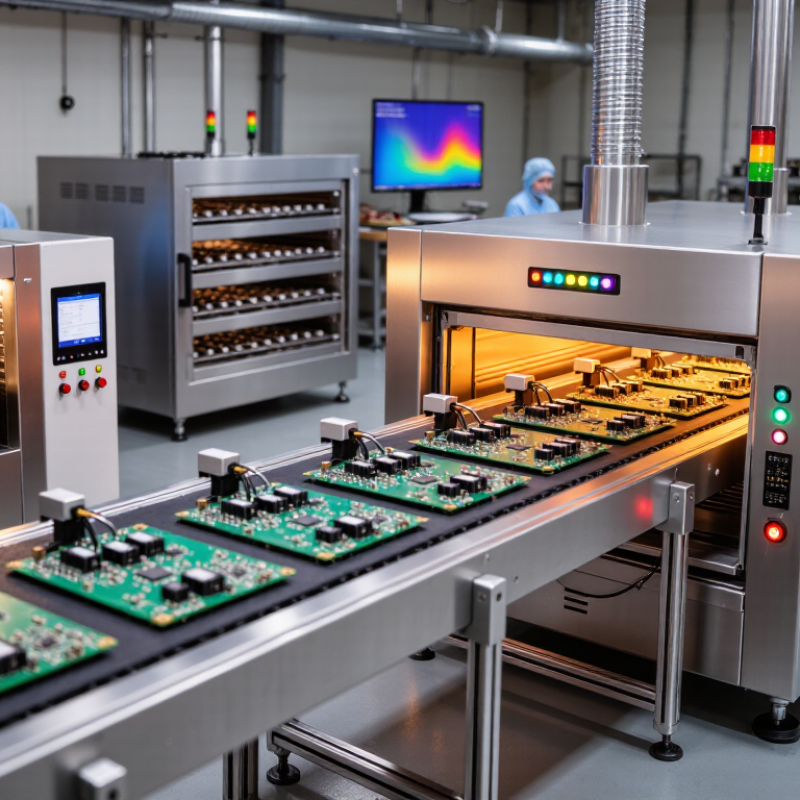
Reflow soldering bonds components to a printed circuit board using solder paste, heat, and controlled cooling. A stencil deposits paste onto copper pads; pick-and-place equipment sets components onto the tacky deposits. The board then travels through oven zones. Simple in concept. Not simple in practice.
In preheat and soak zones, the board warms gradually, helping reduce thermal shock and activate flux. The reflow zone melts the solder; cooling then forms solid joints. For common SAC305 lead-free solder, the liquidus temperature is about 217°C, according to IPC J-STD-006. That is not the oven’s required peak temperature: the correct profile depends on the components, board mass, and paste supplier’s limits. IPC-7530A, IPC’s temperature-profiling guideline, emphasizes measuring the board’s thermal profile rather than trusting the oven display alone.
A convection reflow oven suits many PCB lines because circulating hot air heats boards consistently, but complex layouts can still create uneven temperatures. A thermocouple attached near a large connector or dense component reveals what the board actually experiences. Small details matter. An overheated joint may damage a component; insufficient heat can leave weak solder connections. Even a well-tuned profile deserves periodic checks, since loading patterns and conveyor speed can change the result.
How Reflow Machine Types Differ in Performance
What Is the Best Type of Reflow Machine for PCB Assembly?
How Reflow Machine Types Differ in Performance
Reflow machines differ mainly in heat transfer, temperature uniformity, throughput, and operating demands. Convection systems circulate heated air across the board. They suit many standard assemblies and offer flexible profile control.
A well-tuned zone profile can reduce temperature differences between small components and heavy connectors. Still, airflow may struggle around dense or unusually shaped boards.
Vapor-phase systems transfer heat through condensing vapor, creating consistent temperatures across complex assemblies. This can help when components have different thermal requirements. Their cycle time and fluid handling needs may affect production planning.
Infrared systems heat surfaces directly and can respond quickly. However, component color, material, and shadowing may cause uneven heating. Fast heating is not always better. Review actual board data before choosing.
Tips: Compare measured temperature profiles, not brochure claims. Use a test board with thermocouples on both small parts and heavy components. Check line speed, changeover time, maintenance access, and energy use. One detail is easy to overlook: a machine that performs well on a simple board may need substantial tuning for a dense design.
Factors That Determine the Best Reflow Machine
The best reflow machine depends on the boards, solder process, and production pace—not on the number of heating zones alone. Start with the largest and heaviest assemblies you expect to run. A thick board with large copper areas heats differently from a small, lightly populated controller. Check that the machine can carry the board securely and maintain a stable temperature across its width.
Throughput matters, but so does thermal control. Compare the required line speed with the oven’s usable heating length and zone arrangement. Then confirm that its profile can meet the solder paste supplier’s recommendations, including ramp rate, soak time, and time above liquidus. A profile that works for one assembly may damage another. Keep a temperature logger and test representative boards; guesswork is expensive.
Consider utilities, maintenance, and future product changes. Convection performance, exhaust capacity, nitrogen availability, and filter access can affect daily operation. Ask operators how easily they can clean the chamber and repeat a saved profile. That matters. A machine with extra capacity may be sensible for varied production, while a simpler unit can suit stable, lower-volume work. I would not choose from specifications alone: floor space, operator skill, and actual board samples can change the decision. Small details count.
Matching a Reflow Machine to Production Needs
What Is the Best Type of Reflow Machine for PCB Assembly?
Matching a Reflow Machine to Production Needs
Choosing a reflow machine starts with the boards, not the brochure’s maximum conveyor speed. A high-mix shop may benefit from flexible recipes and quick changeovers. A steady, high-volume line usually needs consistent throughput and minimal temperature variation across the belt. Board width, component density, and copper mass all affect heat absorption. A heavy power board may need a slower, carefully tuned profile than a small controller. Not just speed. Check the available heating zones, conveyor width, exhaust capacity, and profile-recording tools against your actual products.
Grand View Research estimated the global PCB market at USD 73.4 billion in 2023 and projected a 5.6% compound annual growth rate from 2024 to 2030. That growth points to expanding demand, but it does not tell any single factory how large an oven to buy. Base the decision on measured line utilization, product mix, and planned shifts. Run representative boards through trials, then inspect solder joints and profile data at different conveyor positions. For nitrogen use, compare the expected quality benefit with supply and operating costs. A small pilot board can mislead. I would also leave some capacity for future products; forecasts change, and unused capacity can become an expensive habit.
What Is the Best Type of Reflow Machine for PCB Assembly? - Matching a Reflow Machine to Production Needs
| Reflow Machine Type | How It Transfers Heat | Main Advantages | Considerations | Best Production Match |
| Convection reflow | Circulating heated air or process gas transfers heat to the PCB and components. | Widely used for surface-mount assembly; supports controlled multi-zone heating and cooling; suitable for many board and component combinations. | Results depend on profile settings, airflow, board layout, and load. Dense or thermally varied assemblies may need careful profiling. | General-purpose production, including mixed board designs and medium-to-high-volume assembly. |
| Vapor-phase reflow | Vapor condenses on cooler surfaces and releases heat; the process fluid’s boiling point sets an upper temperature limit. | Condensation can provide consistent heat transfer across assemblies with varied thermal masses; the temperature ceiling can help limit overheating. | Requires management of the process fluid and compatible operating procedures. Cycle time and throughput depend on equipment and process setup. | Assemblies with challenging thermal mass differences, temperature-sensitive parts, or specialized process requirements. |
| Infrared reflow | Infrared radiation heats the PCB and components directly, with heat also spreading through the assembly. | Can offer a straightforward heating arrangement and may suit simple, consistent assemblies or lower-volume work. | Heating can vary with surface color, material, component geometry, and shadowing; uniform results may be harder to achieve on complex boards. | Simple or relatively uniform assemblies, prototyping, and production where the board design is well suited to radiant heating. |
| Hybrid convection and infrared | Combines circulating heated gas with radiant heating; the contribution of each method depends on machine design. | Can combine broad convective heating with direct radiant energy, offering process flexibility for suitable applications. | Performance is equipment-specific. Recipe development and board-level profiling are still needed to verify uniform heating and solder-joint quality. | Production requiring a balance of heating methods, especially when the selected configuration has been validated for the board mix. |
Selection tip: Compare machines using representative boards, component temperature limits, required throughput, available floor space, and energy or process-fluid needs. Validate the thermal profile on the actual assembly before production.