Best Negative Thermistor Types for Effective Temperature Sensing?
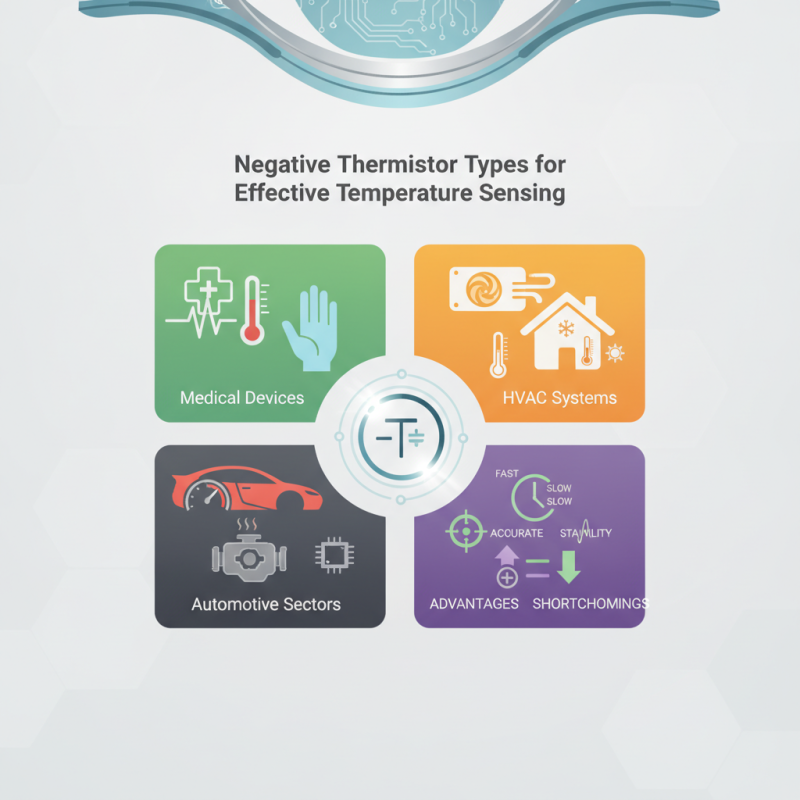
Negative Thermistors are essential components in temperature sensing systems. They offer precise measurements across a wide temperature range. This capability makes them popular in various applications, including medical devices, HVAC systems, and automotive sectors.
Choosing the best negative thermistor can be challenging. Different types exist, each with unique characteristics. Some models provide faster response times. Others deliver better stability and accuracy. Understanding these differences is crucial for optimal selection.
In this article, we will explore the most effective types of negative thermistors. We'll discuss their applications, advantages, and potential shortcomings. By gaining insight into their features, users can make informed decisions for their specific needs. Efficient temperature sensing relies heavily on the right thermistor choice. Therefore, recognizing the best options is vital for success.
Types of Negative Thermistors for Temperature Sensing Applications
Negative thermistors, known for their negative temperature coefficient (NTC), are pivotal in temperature sensing applications. These sensors are widely used in industries like HVAC, medical devices, and automotive systems. According to a report by MarketsandMarkets, the global NTC thermistor market is projected to reach $1.5 billion by 2026. This growth emphasizes the increasing reliance on precise temperature measurement.
Several types of negative thermistors cater to different applications. The most common include bead thermistors, disk thermistors, and chip thermistors. Bead thermistors are often chosen for their rapid response times. In contrast, disk thermistors offer enhanced stability and accuracy. For compact applications, chip thermistors are ideal due to their size and reliability. Each type has its strengths, and choosing the right one can significantly impact performance.
Tip: When selecting a thermistor, consider the required temperature range and response time. Understanding environmental factors is crucial too. Not all thermistors perform the same in varying conditions. Testing each type in real-world scenarios can reveal strengths and weaknesses that specifications alone do not disclose.
Principles of Operation for Negative Temperature Coefficient Thermistors
Negative Temperature Coefficient (NTC) thermistors play a crucial role in temperature sensing. Their primary characteristic is that resistance decreases as temperature increases. This property allows them to provide precise temperature readings in various applications. NTC thermistors are highly sensitive and can detect even minor temperature changes. This sensitivity makes them invaluable in areas like HVAC systems and consumer electronics, where accurate temperature data is essential.
The operation of an NTC thermistor relies on semiconductor materials, typically metal oxides. These materials create variable resistance based on thermal energy changes. As temperature rises, the atoms in the material vibrate more, allowing electrical current to flow more easily. This relationship between temperature and resistance enables effective temperature monitoring. However, challenges arise in extreme temperature ranges, where their response may become nonlinear. Careful calibration can help mitigate these issues.
Despite their advantages, NTC thermistors have limitations. Their performance can be affected by ambient conditions and thermal lag. This lag can lead to delays in response time, which may compromise accuracy. Regular recalibration may also be necessary to maintain reliable operation, especially in dynamic environments. Therefore, understanding their principles of operation is key to using them effectively.
Key Characteristics of Effective Negative Thermistors
Negative thermistors are crucial for effective temperature sensing. Their unique characteristics make them ideal for various applications. The primary feature is their negative temperature coefficient (NTC), which means their resistance decreases as temperature increases. This property allows them to provide accurate and timely temperature readings.
For instance, research from the Global Terahertz Technology Market Report indicates that the need for precision in temperature sensing in industries like healthcare and automotive drives thermistor development. High sensitivity and fast response times are essential. Effective negative thermistors should also have a stable resistance-temperature relationship to ensure consistent performance. This trait is vital in applications that require precise control, such as in HVAC systems or medical devices.
Tip: When choosing a negative thermistor, consider the temperature range and responsiveness. Select models that align with your application requirements.
Incorporating environmental factors is also important. Humidity and mechanical stress can impact performance. Ensure thermistors are rated for conditions they will face. This adjustment can enhance durability and reliability.
Tip: Regularly calibrate your thermistors. This practice ensures accurate readings over time and can prevent costly mistakes.
A few manufacturers fall short in product specifications, which highlights the need for due diligence when selecting components. Always review datasheets closely for details.
Applications of Negative Thermistors in Temperature Measurement
Negative thermistors play a vital role in temperature measurement across various applications. These devices are sensitive to temperature changes, making them suitable for precise sensing. Their resistance decreases with rising temperatures, which is an inherent property used in diverse industries. For example, in HVAC systems, negative thermistors consistently help regulate temperatures for optimal energy efficiency.
According to a report by the International Society of Automation, the demand for temperature sensors in industrial processes is projected to rise significantly, with a growth rate of around 5.3% annually until 2026. This trend highlights a growing reliance on accurate temperature monitoring. Negative thermistors are not only affordable but also provide rapid responses to temperature fluctuations, making them ideal for use in medical devices and automotive applications.
However, challenges do exist. The effectiveness of negative thermistors can depend on factors like the surrounding environment and thermal coupling. The non-linear response at extreme temperatures may lead to some inaccuracies. Addressing these factors requires careful calibration and selection practices, emphasizing the need for further research and development in thermistor technology.
Best Negative Thermistor Types for Effective Temperature Sensing
This bar chart illustrates the effective temperature sensing capabilities of various negative thermistor types. The NTC thermistor demonstrates the best performance at lower temperatures, making it ideal for precise temperature measurement applications.
Selection Criteria for the Best Negative Thermistor for Your Needs
When selecting a negative thermistor for temperature sensing, several criteria come into play.
Consider the temperature range you need to monitor. Different thermistors operate effectively within specific ranges. For precision applications, choose one with a low tolerance level.
Next, think about the thermistor's resistance at room temperature. A common choice is 10k ohms. However, it might not suit every situation. Higher resistance thermistors provide greater sensitivity, yet they may also have slower response times. Balance is key.
Additionally, examine stability and reliability over time. Environmental factors like moisture and dust can affect performance. It’s vital to understand these influences. While some thermistors excel in stability, their cost might be higher. Reflecting on these points helps ensure that you select a suitable thermistor for your application. Keep in mind that trial and error can guide you toward the best choice.