Best Industrial Centrifugal Fan Options for Your Needs?
In the world of industrial processes, choosing the right equipment is crucial. An "Industrial Centrifugal Fan" plays a vital role in ensuring efficiency and airflow management. Dr. Emily Caldwell, a leading expert in industrial ventilation, once stated, "Selecting the correct fan type can significantly impact overall system performance." This highlights the importance of making informed choices.
Understanding your specific needs is essential. Different applications require different fan designs and specifications. For example, high-pressure systems might need specialized models. Due to the vast options available, it can be overwhelming. Not every fan is suitable for every task.
Reliability and performance are non-negotiable factors. Regular maintenance and proper selection can improve longevity. However, a common mistake is to overlook the fan’s capacity or energy efficiency. These details matter significantly in reducing operational costs. Choosing an Industrial Centrifugal Fan is not just about price; it’s about overall system performance and sustainability.
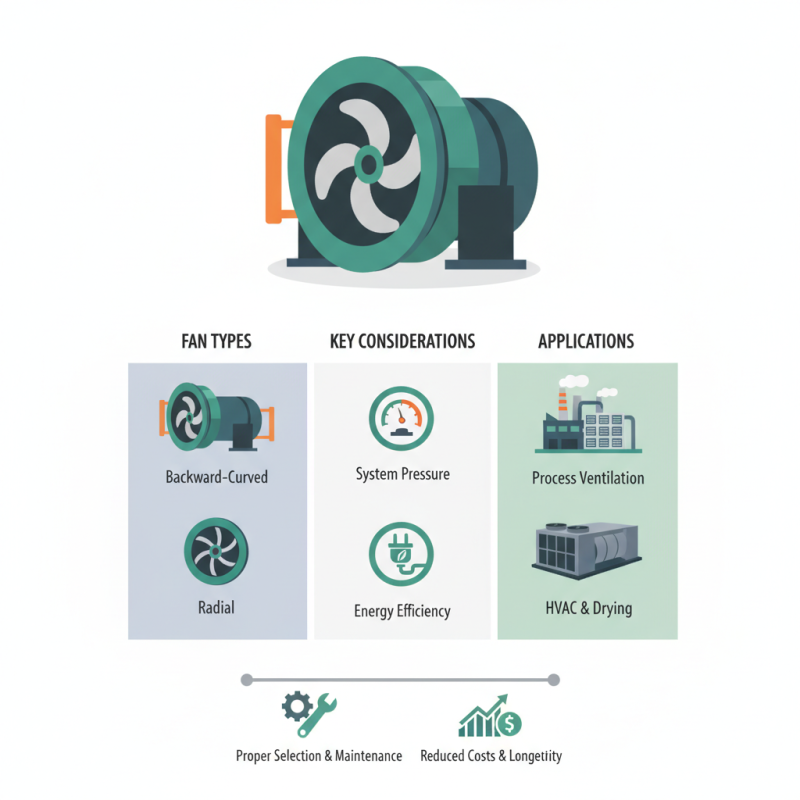
Types of Industrial Centrifugal Fans and Their Applications
Industrial centrifugal fans play a vital role in many sectors. Their types vary widely, catering to specific needs. A common type is the backward-curved fan. This design is efficient and can handle large volumes of air against moderate resistance. It is widely used in HVAC systems and material handling.
Another type is the forward-curved fan. These fans are compact and lightweight. They can move a considerable amount of air at lower pressures. Common applications include residential ventilation and small industrial processes. The choice between these types depends on your specific air flow requirements and system setup.
Consider the implications of using the wrong type. An inefficient fan can increase energy costs. It may also lead to inadequate airflow, causing equipment damage. Understanding your requirements is crucial. A well-informed choice can enhance performance and lifespan. Different environments demand tailored solutions. Don't overlook the importance of expert advice to ensure reliability.
Key Factors to Consider When Choosing a Centrifugal Fan
Choosing the right centrifugal fan can be challenging. Key factors should be assessed to ensure optimal performance. Consider airflow requirements first. Determine the volume of air needed for your application. Too little airflow can lead to inefficiency, while too much can create excessive noise.
Next, evaluate static pressure. Understand how resistance in your system affects airflow. Centrifugal fans work differently based on these pressures. Noise levels are also crucial. Fans with higher efficiency often produce less noise. Check decibel ratings before making a decision.
Material and durability are other vital aspects. Fans exposed to harsh conditions need robust materials. Consider environmental factors like humidity and temperature. Maintenance ease is another area that deserves attention. Hard-to-reach components can add to long-term costs. Make sure replacement parts are readily available.
Top Brands of Industrial Centrifugal Fans on the Market
When it comes to industrial centrifugal fans, choosing the right brand is essential. Various manufacturers offer unique features that cater to different industrial needs. Some fans are optimized for high airflow, while others focus on efficiency. A reliable fan can significantly impact operational costs and system performance.
One well-regarded feature is noise reduction technology. Many top brands have made strides in engineering quieter fans. This can enhance the working environment, but at times, this innovation may not reach all performance metrics. Proper installation and maintenance are crucial in maximizing these benefits. Some brands even provide detailed guidelines for troubleshooting, which can be helpful yet often overlooked by operators.
Furthermore, the build quality varies widely. Certain options promise durability and resistance to harsh conditions. However, not all models live up to these claims over time. It's important to analyze user reviews and performance data. This approach helps to guide decisions based on real-world experiences rather than marketing promises. Balancing cost, performance, and reliability is vital for long-term satisfaction.
Maintenance Tips for Industrial Centrifugal Fans
Industrial centrifugal fans are crucial for ventilation and process applications in various sectors. To maintain optimal performance, regular inspections are necessary. In fact, a recent industry report highlighted that preventive maintenance can reduce downtime by up to 30%. This means more productivity and less disruption in operations.
Cleaning is a fundamental aspect of maintenance. Dust and debris can accumulate and affect efficiency. According to data from the American Society of Mechanical Engineers, even small contaminants can decrease airflow by up to 15%. Using compressed air for cleaning is effective. It helps reach difficult areas. Additionally, checking for vibrations should be part of your routine. Excessive vibrations can indicate wear or misalignment.
Consider lubricating moving parts every few months, based on operational hours. As suggested by the Society of Air Movement and Control Engineers, proper lubrication can extend the lifespan of fan components significantly. It’s crucial to monitor noise levels as well. An increase in noise can often signal potential failures. Maintaining industrial centrifugal fans requires diligence and attention to detail. Ignoring early warning signs can lead to costly repairs.
Best Industrial Centrifugal Fan Options for Your Needs
| Fan Type | Airflow (CFM) | Static Pressure (in. WG) | Efficiency (%) | Maintenance Frequency (months) |
| Forward Curved | 2000 | 4 | 75 | 6 |
| Backward Curved | 3500 | 6 | 80 | 12 |
| Radial Blade | 2500 | 5 | 70 | 9 |
| Tube Axial | 3000 | 3 | 85 | 6 |
Energy Efficiency and Performance of Centrifugal Fans
When selecting an industrial centrifugal fan, energy efficiency is paramount. A well-designed fan can significantly reduce operational costs. Therefore, understanding performance metrics is essential. Look for fans that provide high airflow rates while consuming minimal power. This balance ensures that your facilities run smoothly and cost-effectively.
Ventilation systems benefit greatly from efficient centrifugal fans. These units create robust airflow and help maintain indoor air quality. However, not all fans are created equal. Some may perform well but consume more energy than necessary. It's crucial to evaluate options on both their power consumption and airflow performance. Choosing a fan that excels in energy efficiency can often yield a better return on investment over time.
Furthermore, consider the impact of environmental conditions on fan performance. Factors like temperature and humidity can affect efficiency. Fans operating in harsher climates may need additional features to optimize performance. Inadequate consideration of these details can lead to inefficiency. Regular maintenance is important too. Neglecting routine checks could hinder the fan's output. Remember that performance is not just about initial choices. Ongoing evaluation and adjustment are key to achieving maximum efficiency.